Essay 01December 24, 2025
From Types to Scenes
Ethnographic Photography, Mass Circulation, and the Caucasus in the Russian Empire of the Nineteenth Century
Introduction
Starting in 1800, the Russian Empire conducted a series of large-scale conquests of the Caucasus region, ending with Russia’s victory in the Caucasus War in 1864. The region was unified under the Caucasus Viceroyalty, a special administrative unit of the Empire, which was headed by a Viceroy appointed directly by the Tsar and governed from Tiflis (modern-day Tbilisi, Georgia). By the late nineteenth century, it was subdivided into a layered system of civil and military administration into governorates and oblasts, where legal pluralism was maintained. The region was characterized by its ethnic and linguistic plurality (Turkic, Northern indigenous, Kartvelian groups), yet the administrative units were rarely aligned with ethnic or historical boundaries and instead were designed for efficiency and not representation. With time and an increased consciousness of what this periphery meant to the Empire, there was an increased interest in “knowing” and thus “understanding” these new imperial subjects.1 This couldn’t be done through legal or military means, and there had to be new ways to render the Caucasus legible to both officials and the public. Describing and classifying the region proved a difficult task due to its geographic diversity, social organization, and cultural practices, which resisted easy translation into categories that could have been familiar to the Russian audience.
It was within this context that ethnography emerged as a crucial epistemic tool. With the founding of the Imperial Russian Geographic Society (IRGS) in 1845, and the opening of the Caucasian department in Tiflis in 1851, more and more ventures were taken into documenting the peoples, landscapes, and customs of the Caucasus. These efforts reflected not just scientific curiosity but also an imperial necessity to “know” the periphery in a very Foucauldian sense of knowledge generating power. Ethnography emerged as a means toward closing the gap between administrative control and cultural difference, and hoped to organize the peoples of the Caucasus into “types,” which as with any such endeavour of the nineteenth century, failed to yield satisfactory results.
With the invention of photography in the 1820s, it only took a few years before it reached Russia. Naturally, it found great resonance within the ethnographic and scientific community where it was valued for its objectivity and accuracy and thus for the representation of istinnost’ (truth).2 Early ethnographic photographs of the imperial periphery, including Turkestan and the Far East, were produced within scientific contexts but were secondary sources intended to supplement textual descriptions. These early attempts at “ethnographic” photography emphasized typology, costume, and physiogonomy and thus aligned more with nineteenth-century anthropology and paralleled similar developments in Western Europe.3 As such, photographic efforts developed and in situ scenes that represented the “real life” of the region became more popular, and so did the circulation of these images when photographs were no longer confined to expert circles. By the end of the century, ethnographic images increasingly circulated beyond scientific archives into exhibitions, albums, and illustrated journals that were aimed at a broader readership.4 In this transition towards a mass public, photography’s meaning and visual logic began to change. Certain kinds of images proved more popular while others receded from view.
This paper explores how popular circulation of ethnographic photography was not secondary to the development of this industry but, in fact, an active force that in turn reshaped photographic practice. More broadly, it asks how photographic, visual practices in late Imperial Russia developed different ways of making the populations on the Caucasian periphery visually legible between the 1850s and 1900s, the most active period of this question. As photographs of the Caucasus moved into mass visual culture, the demands of dissemination influenced how difference was staged and framed, which was one of the shifts that ultimately redirected ethnographic photography away from pure classification and documentation and towards more narrative modes of representation. Apart from mass culture, this paper aims to outline the other main intellectual currents that reformed what ethnographic visualization of the periphery looked like for the public, and less attention will be paid to photography within governmental needs past the 1860s. A case study of Dmitri Yermakov, the premier photographer of the Caucasus at the end of the century, will also be offered as a way to more concretely follow the transformation in ethnographic photography. This paper argues that, in the late nineteenth century, ethnographic photography of the Caucasus in the Russian Empire shifted away from strict typological classification toward scenographic and spatial modes of representation, a transformation driven not only by developments within ethnography but by the expanding circuits of mass visual culture that reshaped how photographs were produced, circulated, and understood.
Historical and theoretical context
I’ll first begin with a brief discussion of Russian ethnography in the nineteenth century as it pertains to the relationship to its periphery. Russia had long seen itself as occupying a unique position between East and West, between Europe and Asia. This self-conception was not just ideological but also largely spatial by grounding claims about the “Russian idea” and its distinctiveness in geography. The landmass covering the Russian Empire was seen to be a cohesive, unipartite natural-geographic region which asserted the unity of the Empire as if bestowed by Nature itself (in their view, the European powers were all divided by topography).5 In fact, beginning in the mid-nineteenth century, the view that Russia was on an alternative civilization trajectory to Europe gained more and more attention as the traditional bipartite geographical image was dismissed by thinkers like Nikolai Danilebskii and Vladimir Lamanskii. The idea of Russia as the core of a Eurasian and Slavic “middle world” took charge.6 The empire’s new borderland thus posed an interesting dilemma, as regions like Turkestan and the Caucasus were separated by geographical boundaries, such as the Altai and Caucasus mountains, respectively. It was too difficult to make any geopolitical sense out of these regions, and thus it was easier to label them as “purely Asiatic lands” that were “extraneous historically, ethnographically, and physically”7 and were only included in virtue of their political subjugation to Russia. Though these texts were written only in the 1870s and 1880s, this view had already been popularly established.
On one hand, the internal diversity of the Empire served as a meaningful resource towards differentiating Russia from Western Europe, but on the other, it proved difficult to culturally integrate them into the Empire and undermined the view of the Russian Empire as a unified whole. This is when a stronger desire emerged for ethnography that went beyond classifying people of the Empire. The Rozen School of Orientology, broadly created in the 1880s, attempted to de-essentialize the East and to study the uzly (nodes) of cultural, political, and economic interaction and not just civilization in isolation.8 As with early scholars, they wanted to see Russian culture as a space where the East and the West met (the middle world) but insisted on separating academic Orientology from military and governmental knowledge as the latter was seen as biased. They were especially interested in distinguishing themselves from the clichés of Western Orientalism, condemned European colonization of the Americas, and saw their imperial practices as completely different from those of Western overseas empires. Crucially, they believed that “strong identification with an individual ethnic group and culture…would strengthen, not weaken, a given minority’s attachment to the imperial state.”9
A text written in 1889 by Dmitriy Anuchin, a Russian anthropologist and ethngoraphist, titled O zadachah Russkoi ethnografiyi (On the tasks of Russian ethnography) shows us what the exact goals were. He blamed the current administrative and legislative mistakes of the nation on not knowing the nation well enough. For example, he discusses how some attempts were made an initiating “sel’skie obshiny” (rural communities) in places where such a construction was foreign, and this ultimately failed as beliefs can not be forced onto communities.10 Russian ethnography needed to understand who the narody (peoples) are, what they need, and their spiritual beliefs, all to aid in the “vyrobotki vernogo, istinnogo narodgnogo soznanie” (development of a true, correct national consciousness)11 and to improve the unity of the Empire’s national byt (everyday life). These ethnographic ambitions generated a demand not only for classification and “knowing,” but for representation capable of stabilizing difference and making it legible across the empire. It was within this framework that photography emerged as a tool toward both capturing ethnographic knowledge and circulating it beyond scholarly and administrative contexts.
Popular visual culture in the Russian Empire
Before the 1850s, there were already several traditions in popular visual culture in the Russian Empire. Russian audiences were accustomed to consuming visual representations of the empire’s peoples through established means of mass visual culture. One of the earliest such examples is the 1813 album titled Illustrations de les peuples de la Russie by Karl Rechberg, a comprehensive catalog of engravings showing the narody of the Empire in national dress and in scenes of everyday life. The album emphasized frontal poses, standardized bodily presentation, and careful attention to dress as markers of identity. Even when the prints do capture lived experience, it is “typified” so as to stabilize difference to make it easily compared. For example, there are at least three different illustrations of the insides of yurts of different ethnicities (ostyaks, tatars, and kalmyks), with each showing distinct objects of furniture and activities being performed.12 We see similar poses and subjects being utilized in ethnographic photography several decades later.
One of the most pervasive forms of visual culture, more broadly, was the lubok, inexpensive popular prints that circulated among the public. They appeared in the eighteenth century and could cover everything from religious imagery and Russian mythology to scenes of everyday Russian life and moral lessons.13 The biggest shift came in 1861 with the emancipation of the serfs. Increasingly, people would purchase lubki to “affirm images of themselves through demeaning portrayals of non-Russian within the empire.”14 It seems that with the Emancipation, new minority groups needed to be “orientalized,” especially as the lubki were sold primarily to the lower classes and focused on depictions of daily life rather than images of the royalty or aristocracy (as many illustrated journals did).15 Thus, there was already a tradition of visually depicting and “othering” minority groups, especially nations, of the Empire, and popular visual culture was relatively developed by the time photography entered the stage. Together with illustrated journals and art periodicals, Russian audiences encountered the empire through a visual language already oriented toward classification, typology, and legibility, which in turn would also shape photography and how it was perceived.
Development of ethnographic photography
Photography first began to be considered as a tool for anthropological and ethnographic practices with Nikolai Vtorov. In 1857, he presented the Ethnographic Division of the IRGS with a novel and innovative proposal to use the new medium of photography as a tool in the study of the peoples of the Russian Empire.16 This was the first systematic attempt to use photography in doing ethnographic research, but it never came to fruition. The IRGS regularly published vast amounts of material reflecting their work in Zapiski (literally translates to “Notes”), which was their own publication. But up until this point, the interests and attention of the members of the Ethnographic Division were focused on textual information, and the publications were mostly devoid of visual materials.17 This could also be described by the fact that readership for their publication was largely limited to academics and people interested in the sciences. There appeared, therefore, no real need to appeal to a popular imagination or present anything that was outside of the scientific realm; ethnography was seen as a scientific endeavor.18 Since photography was not yet seen as anything but a tool for military documentation, it wasn’t a part of the scientific realm. But Vtorov saw something in this new tool that perhaps others didn’t, and he went through with his project on his own and independently published his photographs in V.F. Timm’s Russkii khudozhestvennyi listok (Russian Newsletter on the Arts) between 1857 and 1862. This newsletter was one of the first extant publications to focus specifically on visual material (though not just ethnographic) and so supported the projects of those like Vtorov. Though we don’t have most of Vtorov’s material publicly available today, the fact that his ethnographic photographs kept being published for several years points to the fact that there was an increasing interest in such examples of visual culture and in perceiving the rapidly accumulating peripheries. Timm’s Russian Newsletter on the Arts is widely seen to be the first example of a journal dedicated to disseminating visual culture to a broad public, and thus its example is an important development in our genealogy. An image from the 1860 publication shows an illustration with portraits of men and women from the Voronezh gubernya (area) assembled into an image as a sort of compilation.19 Though they weren’t ethnographic strictly speaking (all the portraits are of ethnically Russian peoples), all of them were taken from Vtorov’s photographs and were part of the wider project of “knowing” the Empire. Each person is labeled with a number, and the caption includes the region/province for each, as well as a note saying that they are taken from Vtorov’s album (see figure 1).20 This presents one of the earliest attempts to scientifically assemble the different peoples from the empire, first starting with the non-metropolitan population (Vtorov’s project otherwise included many depictions of the different narody and nationalities). We are still seeing it draw from a scientific approach to ethnography rather than one rooted in cultural consciousness.
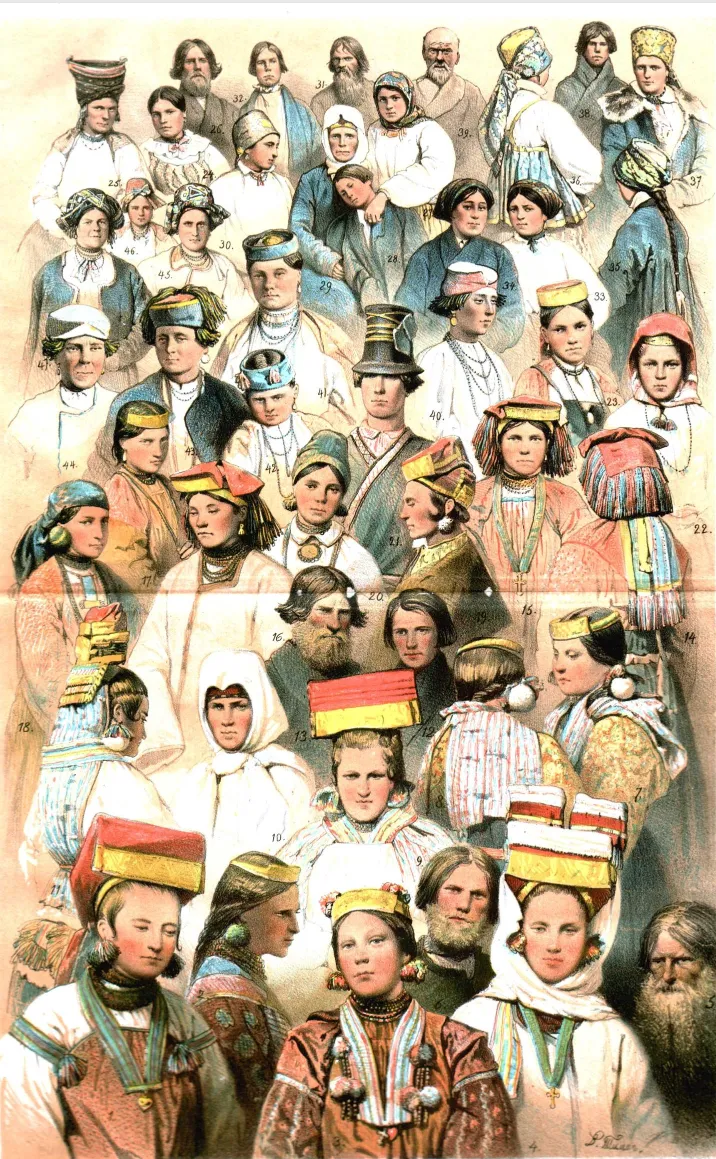
We also see that, as much as IRGS and academics tried to reject Western European ethnography and orientalism of the century,21 there were many natural similarities that we can use to characterize and read development in ethnographic photography in Russia. In Europe at this time, anthropological photography was used as purely a recording medium to correlate other documenting practices and assist with other methods.22 It focused on surface descriptions, such as physical bodies and material culture, and would often seek to map racial and physical characteristics. We see this most in how early anthropological photography utilized black backgrounds to focus on the body and physiognomy.23 The same was the case in the Russian Empire, and the famous Turkestan album proves a useful example. The photographs, split into four parts, that were assembled in the album were taken in the 1860s and were ordered by the Governor-General of the region, Konstantin Kaufman.24 The “ethnographic part,” published in 1871, shows the “tipy narodnostei turkestanskogo kraya” (types of nations in the Turkestan borderland), which presents three photos for the male and female “type” for each nation.25 The photographs support the plain background trope of early anthropological photography and is obviously centered on national dress and physical characteristics. There is no existing example of such a comprehensive, purely ethnographic collection for the people of the Caucasus, but we can imagine that they were viewed similarly in the popular imagination of the empire. It is important to note that this album, though published in the 1870s, was conceived of in the early 1860s with the goal to introduce the peoples of Turkestan to researchers and scholars, and less so to the wider public. All in all, before the mid-1860s, photography was valued for its istinnost’ (truth) and objectivity but was secondary to text and purely a documentary aid. Visual logic included frontal poses, emphasis on costume, “types,” and parallels with earlier engravings like those of Rechberg. Yet slowly over time, photography begins to capture the “abundance of culture,” including social behaviors, gestures, and daily life rather than just biological or material aspects.26 The 1867 Ethnographic Exhibition is a crucial node in understanding this shift.
1867 Ethnographic Exhibition
The exhibition was the first large-scale exhibition project in the history of the Russian Empire that gave a powerful impulse to the development of Russian scholarship in ethnography, anthropology, archeology, and history.27 The originality of the exhibition manifested itself in a variety of areas, but most critical for us was the choice to display photography in a separate section. Such a decision drew attention to photography’s cultural and historical importance and relevance for the time. It also allowed the metropolitan, educated Muscovite public to glimpse into life in different parts of the empire, of which they mostly had only a very vague idea.28 The exhibition itself was unprecedentedly expansive, being split into three sections: one for “displays of the tribes inhabiting Russia and neighboring Slavic lands,” the general ethnographic section, and the anthropological section.29 It is in the ethnographic section that we find over 1500 photographs, most of which retained the aesthetics and subject matter of ethnographic photography up until this time. In fact, each ethnic group was represented by mannequin figures (295 in total) which were dressed in anthropologically accurate national costumes and were shown in their authentic environment, and all were based on photographic records.30 The choice to use photographs as the basis for these mannequins was made at the very first meeting of the Committee in 1865 and reflects how the photographic market was flourishing by the middle of the decade and its use in various fields was getting more popular. What was even more interesting was how these photos were collected. Already in 1865, there was an announcement sent out from the committee looking for photographic material that they were collecting from both amateurs and professionals. They highlighted several conditions that they were looking for: the photographs had to show all parts of the national costume, the choice of people photographed had to depend on how well their appearance reflected the “typical” physiognomy of the narod, as well as include anthropometric information.31 On this basis, photographs were selected and exhibited, all of which were numbered in accordance with the catalog published contemporaneously with the exhibition. We see many examples of photographs that perfectly align with the “blank background” types of the preceding decades, but there is now a large amount of in-studio photographs. For example, we see one titled “house and courtyard in the village of Mal’chitsy”(see figure 2)32 where the people are now the secondary subject and are placed in the background with their environment taking center stage. Another example is “a Tatar wheeler” (see figure 3),33 which shows a man on a wheelbarrow who is no longer elaborately dressed and appears to be captured in the middle of his everyday life. These changes were admittedly also brought on by advancements in photographic technology, but we nonetheless cannot ignore the obvious choice to dedicate this much attention and time to the photographic project and its objectivity within the Exhibition. This appears to have been the first large step towards making the peoples of the empire legible for the broad Russian public.
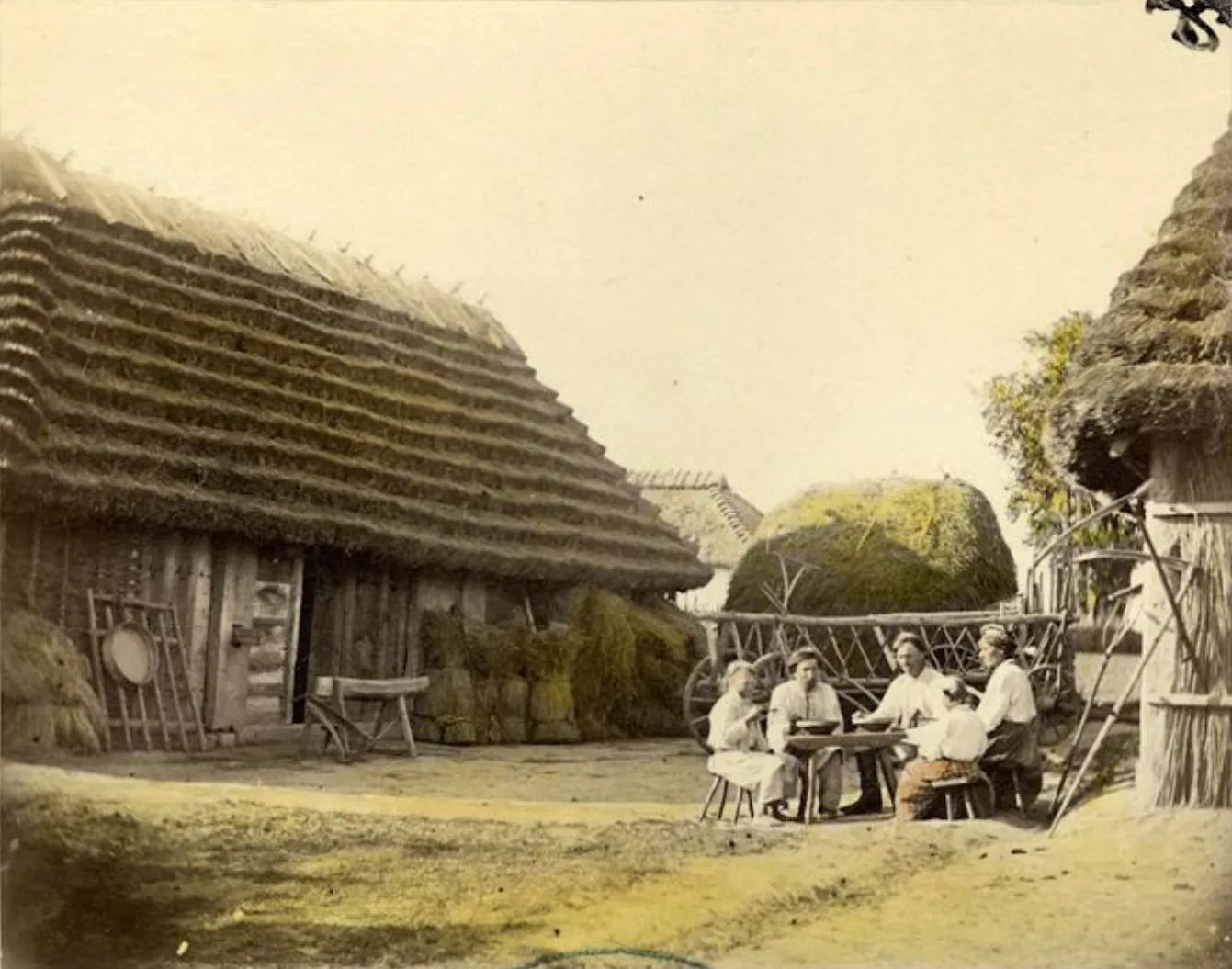
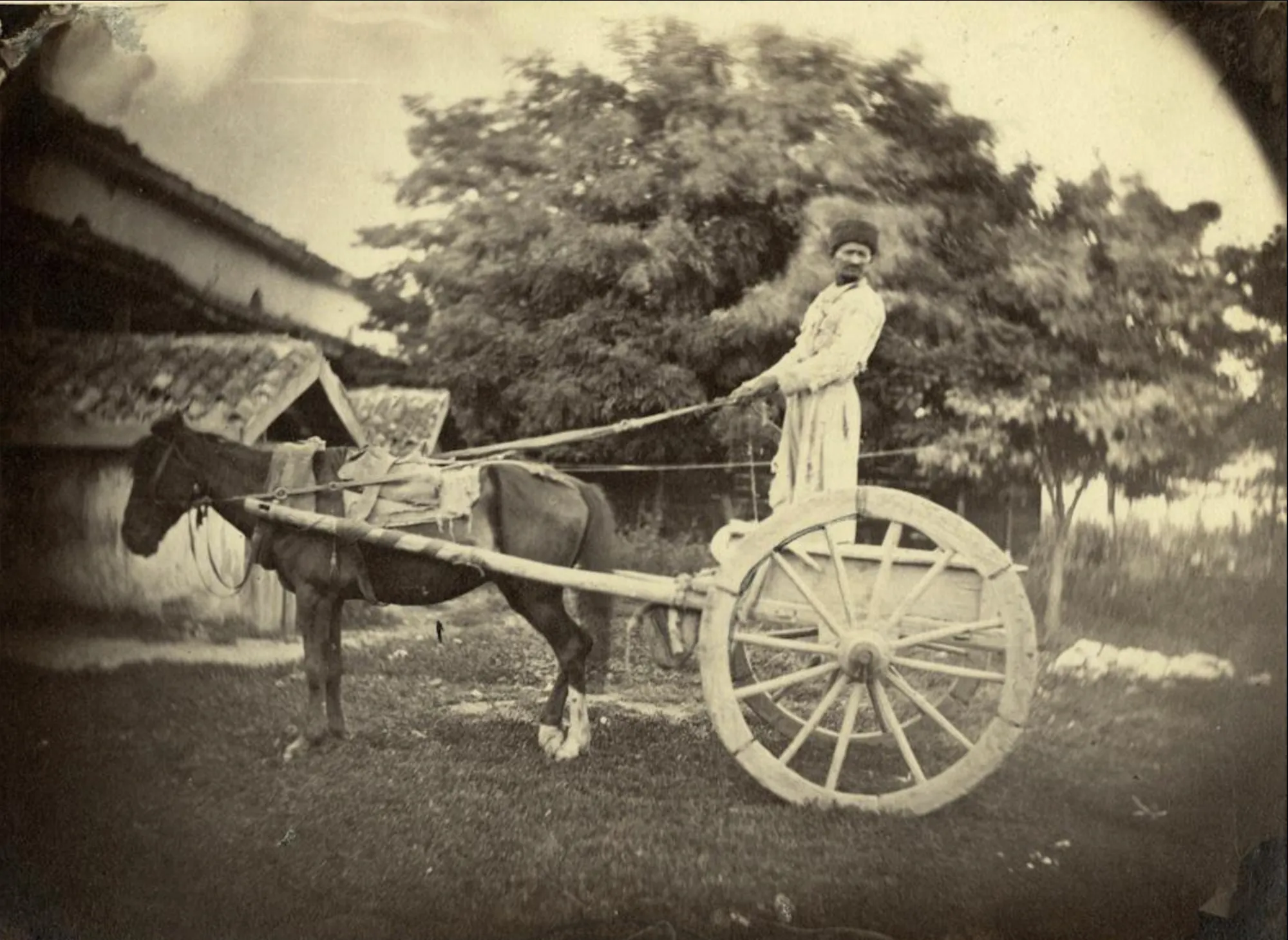
The scenographic environments of both photography and other sections of the exhibition were an important development in how the narody of the empire were imagined. It was also a sort of climax in the tension between scientific systematization and visual effect for the public, and the moment of the exhibition reframed photography’s function. Photography becomes a methodological bridge between 19th and 20th century anthropological practices and marks the transition towards a focus on cultural and social analysis.34 The “understanding” of people from a cultural point of view had only been done thus far by literary men. Indeed, there was a dramatic switch to realism from romanticism in Russian literature and painting a few decades earlier. Writers like Ivan Turgenev “criticized the essentialist romanticism of many depictions of the peasantry”35 and turned to focusing on portraits of popular life as they saw art as subordinated to reality. Unlike literary ethnography of the 1830s and 40s, such as Mikhail Lermontov’s “A Hero of our Time” where the Caucasus is portrayed as a beautiful, yet untamed and dangerous frontier, realist literature often had a didactic intent and focused on istinnost’ (truth).36 Regional differences were increasingly acknowledged, and this diversity came to define nationhood: it was now less a question of direct cultural assimilation and more a hope of studying these people to understand them.37 Similarly, we see these currents reflected on photography in the attempts to gain a scientific understanding of the wider environment of tangible and intangible culture,38 which now included much more than physiognomy and dress. As such, photographs begin to work and be read without explanatory texts and as ends in themselves. Yet this could only be achieved by popularizing the medium as something more than just pure documentary, and this was, once again, accomplished through mass circulation.
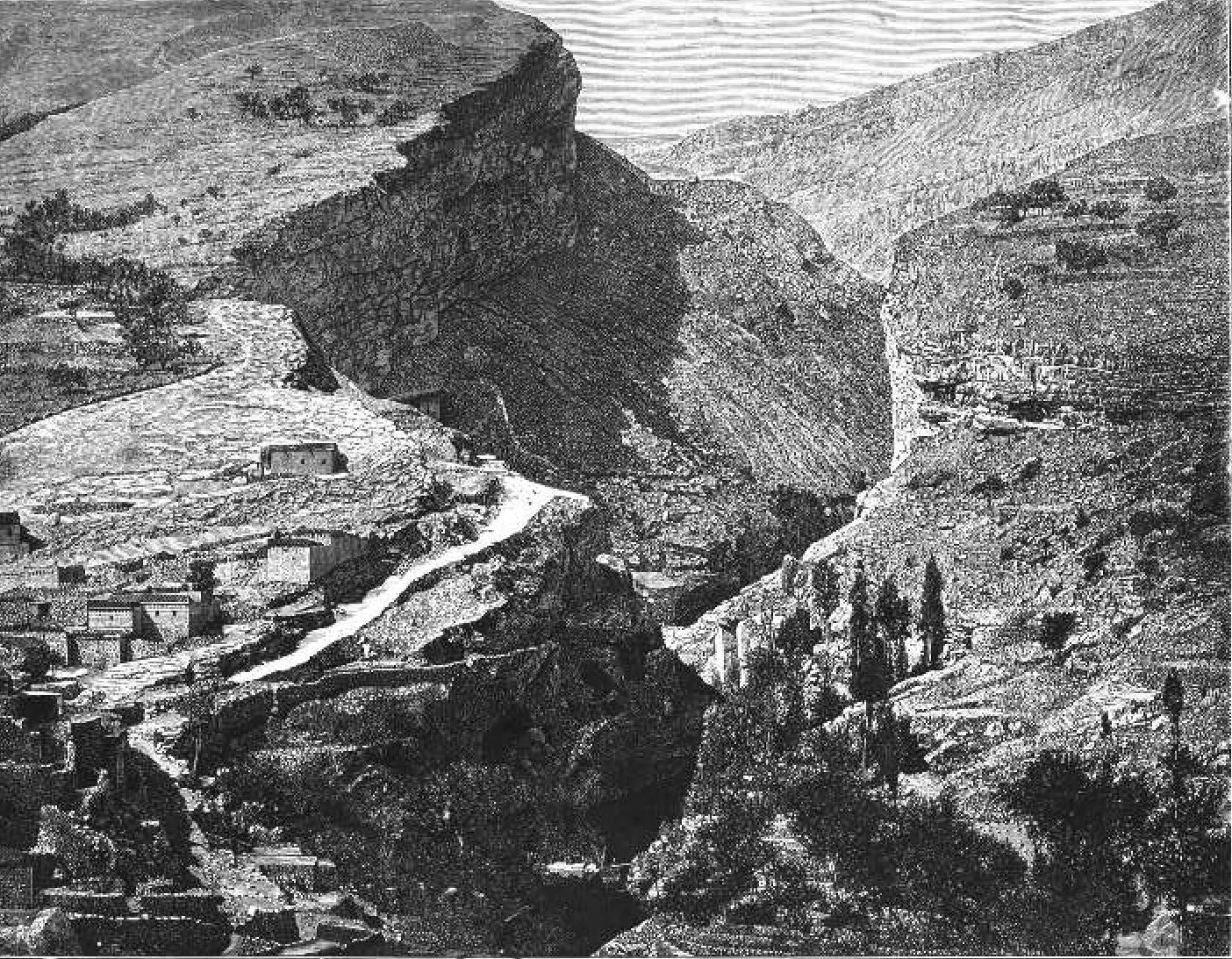
The 1867 Exhibition naturally marked a turning point, as photography would now find its way into everything from gift albums to illustrated journals, and would also become a central aspect of museology and curatorship. А fruitful example is the Niva journal, started in 1870, which would become the cheapest yet most successful weekly magazine of the Empire positioning itself as an illustrated journal of literature, politics, and modern life.39 Representations of the peoples and terrains of the Caucasus were particularly interesting as they were most “foreign” and thus curious for a mass readership. Though photography did not appear as mechanically reproduced photographs until the start of the twentieth century in the journal, many illustrations and engravings were derived explicitly from photographic sources. These images would now situate the narody within spaces that implied social relations and modes of life. While these scenes retained typological legibility (such as costume), they were supplemented with narrative cues which rendered difference more intelligible and, perhaps more importantly, engaging. In the 1890 publication, for example, there is an engraving that is labeled to have been taken “from a photograph” and shows a zoomed-out view of a village in the North Caucasus (Naskent) (see figure 4).40 There are no longer any people, and instead, the illustration is focused on the geographical terrain and architecture of the village. This signals a turn away from bodily typology and physical typification and towards a spatialized mode of ethnographic seeing. Visualizing the terrain and built environment of the Caucasus reflected not just what was most engaging for the public, but also intellectual currents such as the aforementioned Rozen school and Anuchin’s writing on what Russian ethnography should become. As mass visual culture garnered popularity, it started to exert pressure on photography as images now had to be appealing and interesting rather than purely classificatory, which they were when the audience was still purely academic. Following the 1867 Exhibition, ethnographic photography was no longer ethnographic in a strict sense and was shaped more by the demands of popular visibility and less by anthropological debates. In Niva’s 1894 publications, several other engravings “from photographs” are interesting in their subject matter. One shows the “general view of Abas-Tuman,”(Georgia) (see figure 5),41 which is again a photograph from afar of the village, focusing on how the houses and streets fit into the mountainous terrain, and is largely devoid of people. The second is one called “in the Caucasus mountains. The holiday of Tatartub” (see figure 6),42 which shows a chaotic scene of what looks like games on horses and people cheering. All are dressed in traditional Caucasus dress, but it does not specify which of the narody of the Caucasus are being depicted, a deviation from the earlier care taken to categorize every “type” within the region. This categorization is very obviously not the goal anymore, as the public becomes more interested in the cultural landscapes and contexts of the borderlands. Crucially, too, in the background we see a “typical,” mountainous Caucasian village, like those that have been included prior. All of these points to a post-1867 transformation in ethnographic photography, in which the Caucasus came to be understood less through the classification of bodies and more through scenographic views of space, landscape, and built environment, shaped by popular interest rather than by strict anthropological and scientific audiences and objectives.
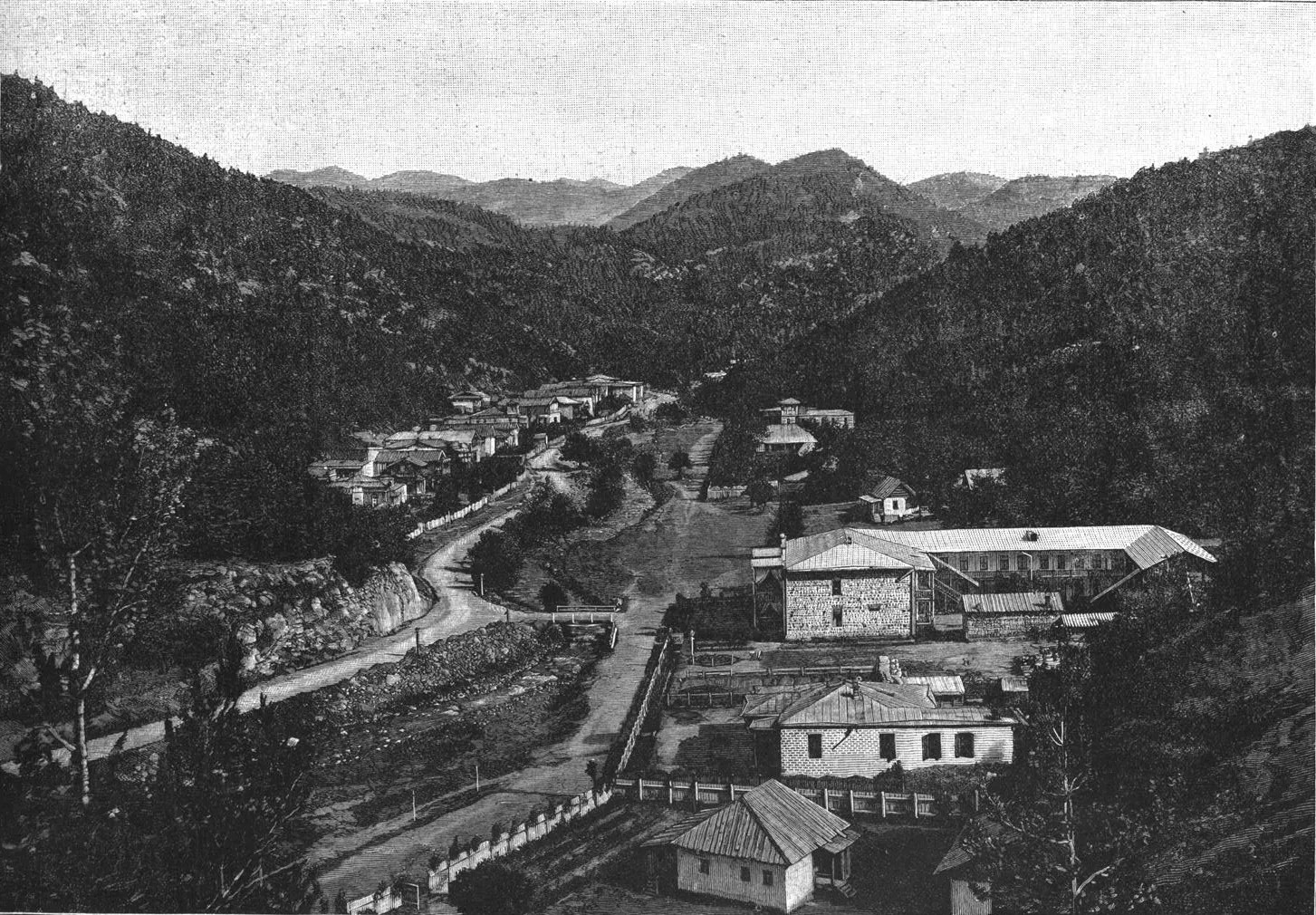
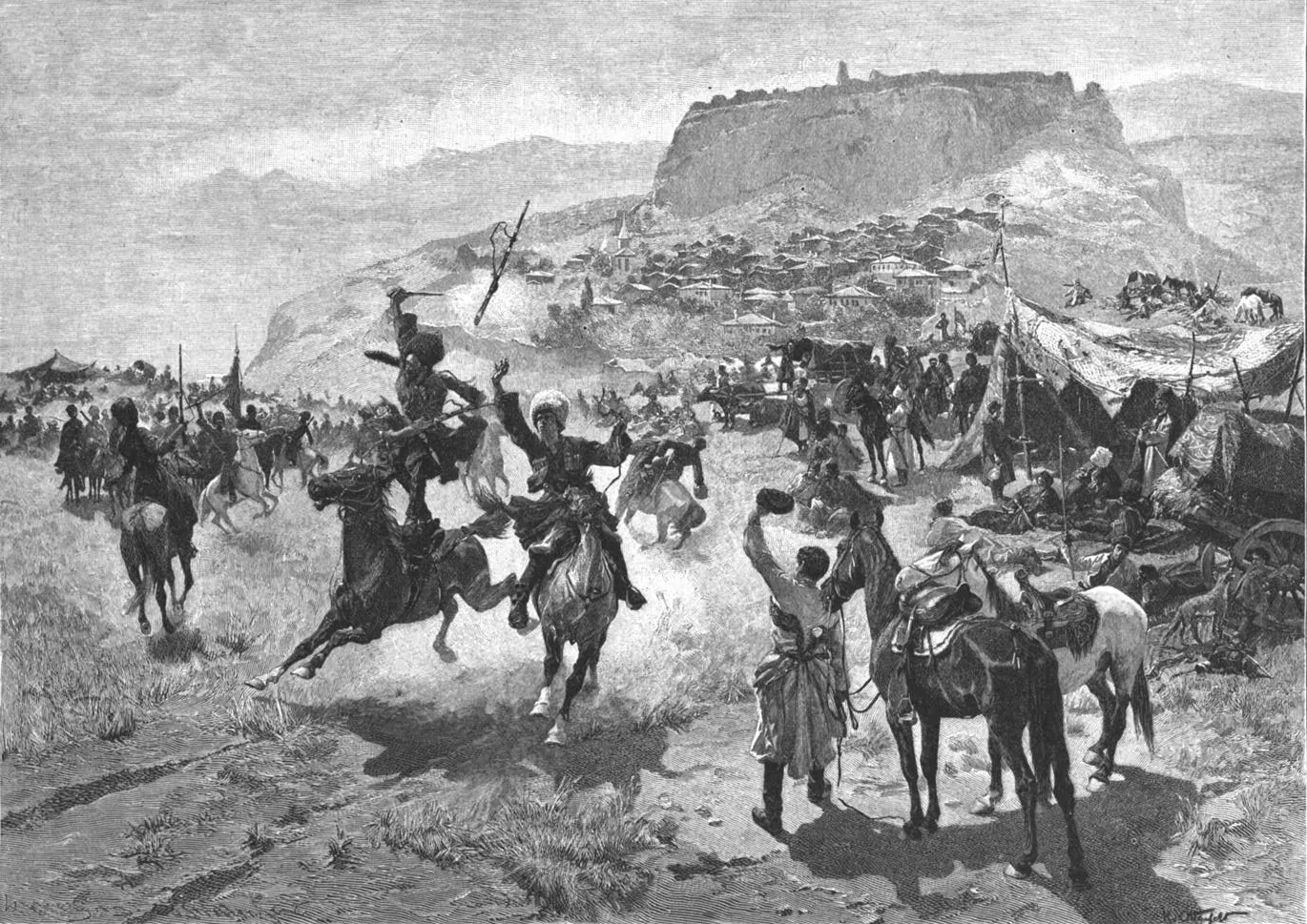
Dmitri Yermakov
To illustrate this shift between 1850 and 1900, I would like to present the case study of Dmitri Yermakov. As the premier photographer of the region, analyzing the evolution of his photographic oeuvre is a fruitful task in seeing how the currents and shifts that have been discussed in this paper actually played out. Yermakov was born in Tiflis, Georgia, in 1846 and was trained as a military topographer, having taken part in the Russo-Turkish War.43 By the mid-1870s, he opened a photo studio in Tiflis and began capturing his extensive travels, especially through the Caucasus. He was interested more in proto-documentary and on-location photography and moved away from staged, studio photography. He even simplified the construction of a camera to make it more mobile and invented a moving, transportable photolaboratory.44 He was the first photographer in the Russian Empire to have given this much thought to photography as a tools toward objectivity: he assembled a sort of encyclopedia of the peripheral regions of the Empire, capturing everything from the ethnographic types to topography and architecture.45 He devoted special attention to the Caucasus as his home region. By 1896, he published a “Catalog of Photographic Views and Types of the Caucasus, Persia, European and Asiatic Turkey” which included over twenty-five thousand negatives, all meticulously labeled and organized.46 The catalogue, which was explicitly designed for distribution and not just for scholarly archiving, is revealing not only for its scale but also for the visual logic that it utilizes. While the title still invokes the language of “types,” the photographs included in the collection move beyond strict typological representation. Alongside studio portraits in national costume, Yermakov devoted extensive attention to village panoramas, domestic interiors, workshops, roads, bridges, and mountain landscapes, often minimizing or fully excluding the human figure.47 In these images, cultural differences are communicated less through bodily classification than through spatial context, material culture, and scenes of everyday life. There is a clear departure from earlier ethnographic photography as comparison between narody was no longer the goal. The goal now was, most of all, to visually incorporate the Caucasus periphery into the Empire.
Yermakov favored siuzhetnaia s’emka (scene-based/narrative photography).48 It is still important to note that when he first opened his photo atelier in Tiflis, he focused primarily on portraits, and especially was interested in the ethnographic “types” of the region, mimicking the currents of the previous decades. But even then, he paid a lot of attention to the composition and poses of models in directing how the body was turned and where the gaze looked to best support the podlinnost’ (authenticity) of the photograph and its model.49 For example, in the 1870s, a Gurian man appears in national dress but is surrounded by “typically Gurian” objects, such as the fur rug and textiles with Caucasian motifs, and even a painted backdrop (see figure 7).50 In the next decade, he almost completely rejected posed studio compositions in favor of photographs taken in situ. This approach was made possible through his innovations in photographic technology, but also in the changing tastes and aims of the Empire and its people. Importantly, this shift towards scenography cannot be read as a rejection of ethnography, but rather a redefinition of how ethnographic knowledge could be visualised. Late nineteenth-century ethnographic photography increasingly turned towards the depiction of sreda obitaniia (lived environment) as a means of understanding culture. The Russian audience could now understand cultural difference as not just a set of bodily markers but also as something socially inhabited.
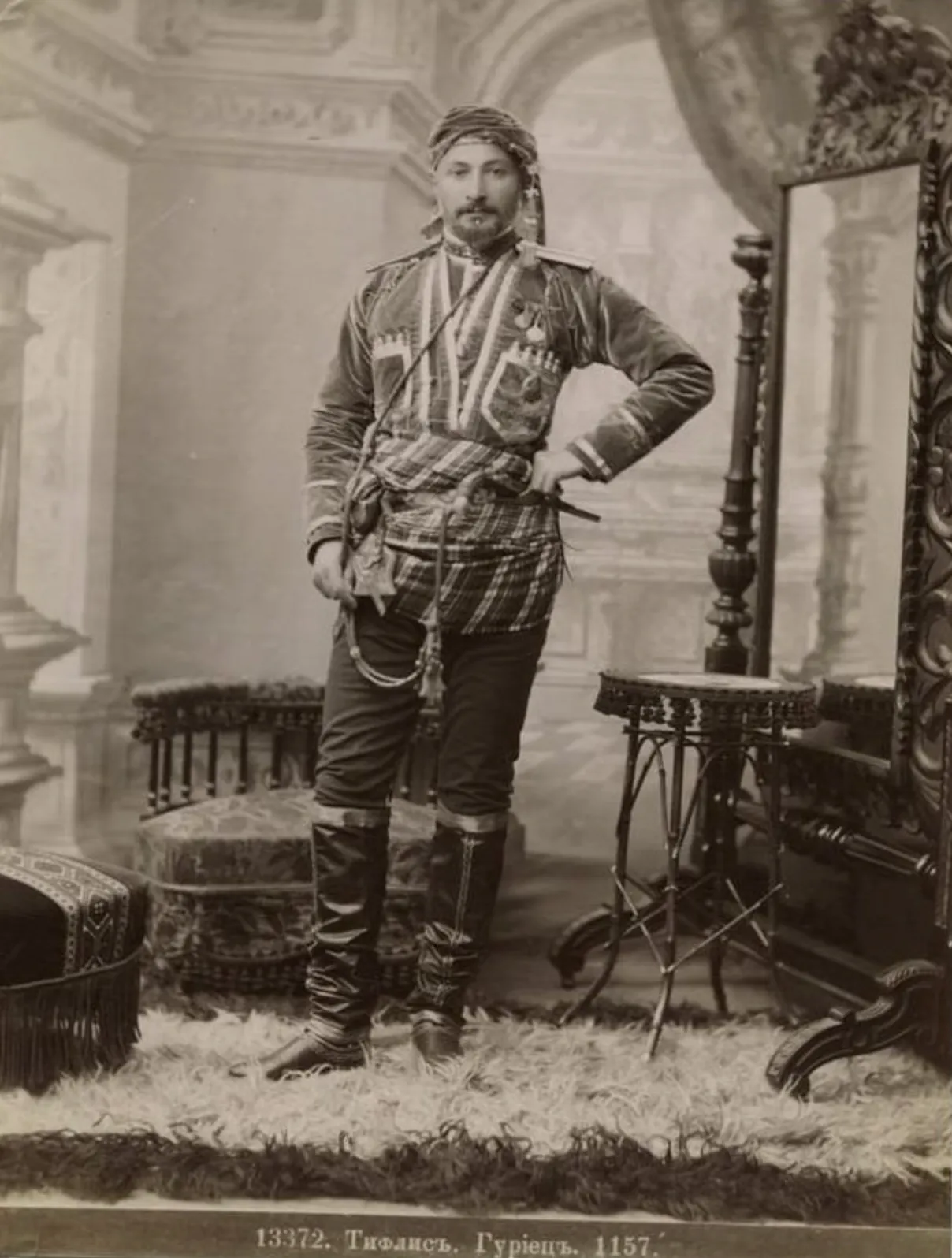
This shift that we see in Yermakov’s work reflects how circulation impacted photography, as has been discussed throughout this paper. Earlier ethnographic photography was produced primarily for institutional archives or academic purposes, whereas Yermakov’s images circulated widely through albums, postcards, and individual prints. Especially significant was his work at the 1879 anthropological exhibition in Moscow, where he was given a medal for his photographs showing the “life of the peoples of the Caucasus.”51 These formats needed images that could function autonomously and would be visually compelling and immediately legible for a wide audience. To help the public “understand” the periphery, Yermakov utilized recognizable landscapes (like those scenes in paintings of the Romantic period) and built environments rather than typological portraits which earlier required a stronger academic background and deeper engagement to be properly read. Mass circulation thus exerted a selective pressure on photographic practice, encouraging the production of images that balanced ethnographic intent with popular visual appeal. A photograph from around 1895 shows a street in Tiflis (see figure 8).52 The men no longer appear in carefully curated national dress and now appear to be in everyday clothes, and they stand among obviously Georgian architecture (with the cantilevered balconies and decorative cornices) with mountains in the background (for the Russian imagination, the Caucasus would have been very strongly associated with mountainous topography). Additionally, the people appear captured mid-action, as if caught in the middle of everyday activity, producing the illusion of immediacy and authenticity. Photographs and scenes became more and more informal and even comical in places. To “unify” the Empire, which had become one of the central aims of ethnography at the end of the century, as shown by people like Anuchin and those of the Rozen school, all of its people had to exist as one in the popular imagination. It thus seems that by capturing everyday scenes, the subjects of the Empire could all connect visually as such subject matters resonated much more with the public.
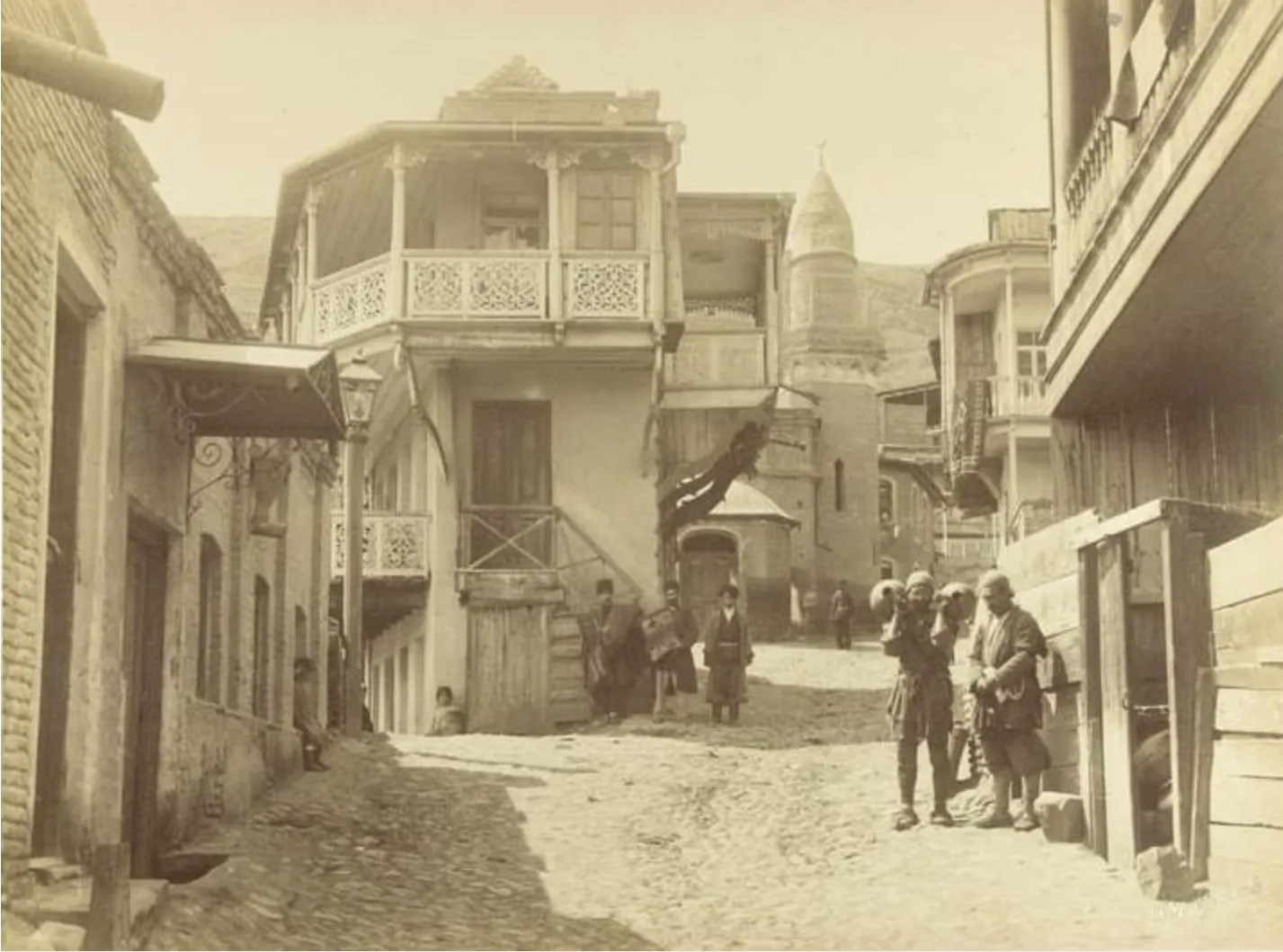
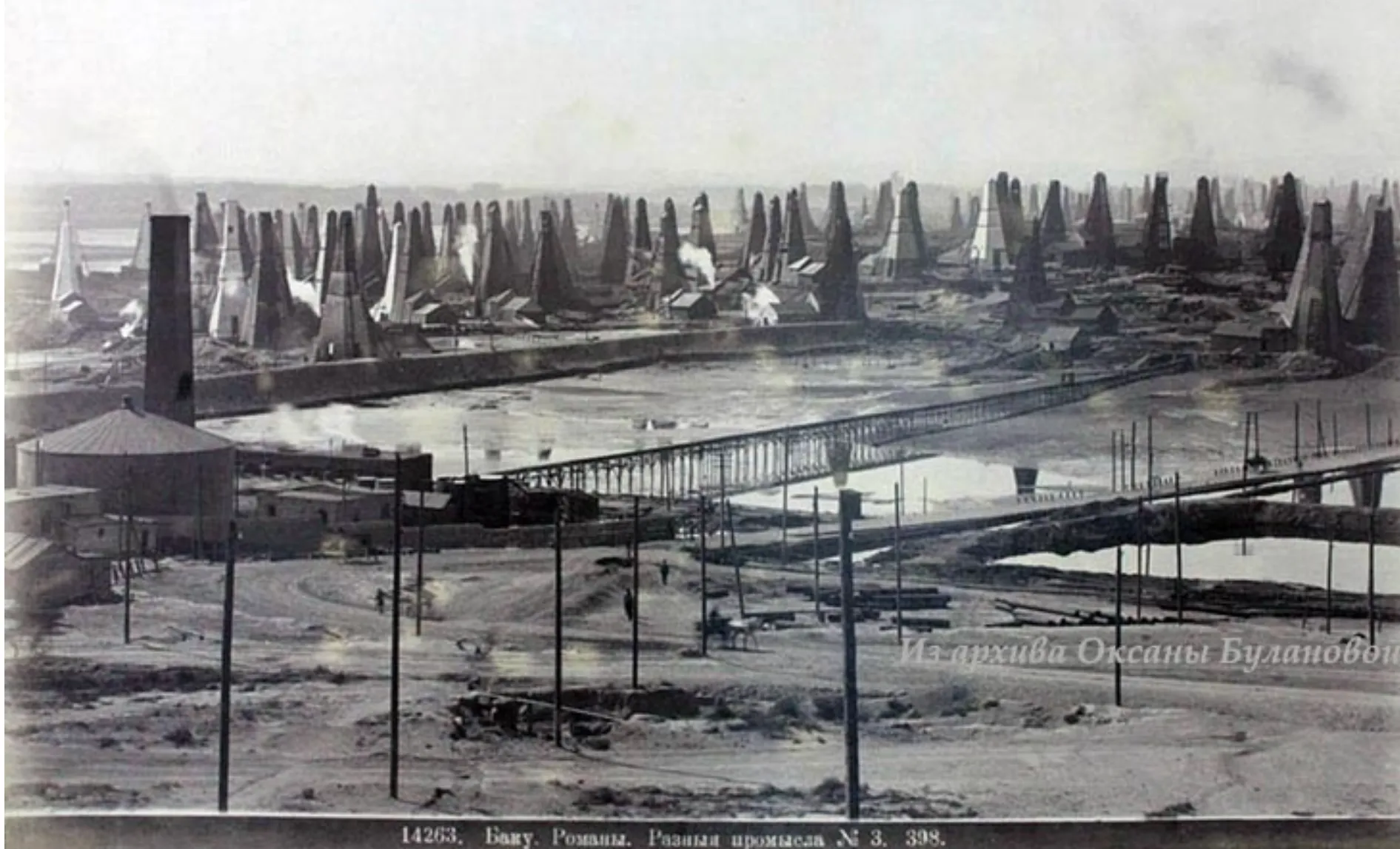
There was also a broader change in how the Empire viewed the Caucasus and what its aims were. The region increasingly emerged as a structured, inhabited landscape, visually integrated into the empire through roads, villages, and infrastructure. The Russian Empire’s borderlands were no longer conceived merely as external “Others” but as spaces through which imperial identity was shaped and defined. We again see this in Yermakov’s later photographs, wher,e by the 1890s, he conducted larger documentary projects of the achievements in the Caucasus in agricultural and industrial advancements and thus positioned the Caucasus as a part of the modernizing Empire. At the beginning of the twentieth century, he conducted a photographic project of the Bakinsky oil settlement (see figure 9).53 There are close to no people, and the infrastructure of industry, which appears to be very actively working with smoke coming out of all of the pipes, takes center stage. Yermakov’s photography was thus part of the shift away from pure classification to making the Caucasus incorporable.
Conclusion
This paper has argued that ethnographic photography of the Caucasus in the late nineteenth century cannot be understood merely through the development of anthropology or imperial practices, but must be read within the expanding field of mass visual culture that reshaped how images were produced and consumed. While early ethnographic practices emphasized typology, classification, and the view of bodies as the main differential quality, the decades following the 1867 Ethnographic Exhibition and the development of the field as a whole saw a reorientation towards scenographic and spatial modes of representation. This shift reflected not only intellectual currents in the Russian Empire, but also, and crucially, the growing influence of mass visual culture, which ultimately “preferred” images that were easily legible, engaging, and capable of being circulated beyond academic and scientific circles.
Illustrated journals, albums, and exhibitions visually introduced the Russian audience to the imperial periphery through landscapes, architecture, and scenes of everyday life rather than through abstracted bodily “types” and categorizations of narody. In this context, photography increasingly functioned as a medium that made the periphery intelligible by embedding cultural difference within space and time, and not just in dress and physiognomy as had been done in the past. The Caucasus, which had long been positioned as both internal and foreign to the Russian Empire, emerged not just as a collection of peoples, who had earlier been seen through the trope of “noble savagery,” but now as a visually integrated region that could be understood and, in ways, connected to by a wide public.
The work of Dmitri Yermakov offers an especially interesting case study for exploring this transformation. Although his catalogues retained the earlier classification and language of “types,” his photographs moved clearly and intentionally towards sreda obitaniia photography, emphasizing environments, material culture, and social relations. His professional practice demonstrated how ethnographic photography adapted to new conditions of circulation by balancing scientific ambition (both in ethnography as a scientific discipline and technological advancements of the century) with the demands and desires of visual accessibility and appeal. Photography, in this sense, was no longer ethnographic in a strict disciplinary sense and instead became a medium through which the Russian Empire’s borderlands were made visible, familiar, and most important for the end of the century, incorporable. By tracing these shifts more broadly, this paper has shown that the transformation of ethnographic photography towards no longer being “ethnographic” was not simply a matter of technological progress or administrative ambitions, but the result of larger changes in how the Russian Empire saw itself and its peripheries through images.
Bibliography
- Anuchin, Dmitri. O Zadachakh Russkoi Etnografii. Moscow: Russkaya Tipo-Lit, 1889.
- Ebersa, Georga. “Iusus–Povestvovanie iz bibleiskih vremen.” Niva 42, no. 1–17, 1890.
- Rechberg, Karl. Illustrations de les Peuples de la Russie, 1813. n.d. Gallica - BnF. https://gallica.bnf.fr/ark:/12148/btv1b2300469z/f110.item.
- Kaufman, Konstantin. Turkestanskīĭ alʹbom, chastʹ ėtnograficheskai︠a︡ : tuzemnoe naselenie v russkikh vladi︠e︡nii︠a︡kh Sredneĭ Azīi. Tashkent, 1871.
- Salaiasa, E.A. “Tartyufochka.” Niva 51, no. 1–26, 1894.
- Timm, Vasiliy. “Poselyane Voronzheskoi Guberni.” Russkiy Hudozhestvenniy Listok no. 1–36, 1860.
- Wilhem, Gerbert. “Sovatal’!.” Niva 51, no. 1–26, 1894.
- Bassin, Mark. “Russia between Europe and Asia: The Ideological Construction of Geographical Space.” Slavic Review 50, no. 1 (1991): 1–17. https://doi.org/10.2307/2500595.
- Brooks, Jeffrey. “The Russian Nation Imagined: The Peoples of Russia as Seen in Popular Imagery, 1860s-1890.” Journal of Social History 43, no. 3 (2010): 535–57. http://www.jstor.org/stable/20685424.
- Clay, Catherine B. “Russian Ethnographers in the Service of Empire, 1856-1862.” Slavic Review 54, no. 1 (1995): 45–61. https://doi.org/10.2307/2501119.
- “Dmitri Yermakov - Vereschagin ot Mira Fotografii”. Cameralabs. Accessed December 23, 2025. https://cameralabs.org/12620-dmitrij-ermakov-vereshchagin-ot-mira-fotografii-i-ego-snimki-russkogo-vostoka.
- Edwards, Elizabeth. “Anthropology and Photography: A Long History of Knowledge and Affect.” Photographies 8, no. 3 (September 2, 2015): 235–52. https://doi.org/10.1080/17540763.2015.1103088.
- Edwards, Elizabeth. “Uncertain Knowledge: Photography and the Turn-of-the-Century Anthropological Document.” In Documenting the World: Film, Photography, and the Scientific Record. Edited by Gregg Mitman, and Kelley Wilder (eds). University of Chicago Press, 2016. Chicago Scholarship Online, 2017. https://doi.org/10.7208/chicago/9780226129259.003.0005.
- “Fotografii na Vserossiyskoy Etnograficheskoy Vystavkа 1867 Goda.” Rossiyskiy Etnograficheskiy Muzei. Accessed December 23, 2025. https://collection.ethnomuseum.ru/entity/ARTICLE/2547.
- Gutmeyr, Dominik. “Decentring Innovation: Circulation of Knowledge and Early (Russian) Photography .” Essay. In Europe and the Black Sea Region, 155–81. Zürich: Lit, 2020.
- “Images of Empire.” ROSPHOTO RSS. Accessed December 23, 2025. https://rosphoto.org/events/images-of-empire/.
- Jersild, Austin. Orientalism and Empire. The Institute for Research on Public Policy, 2003.
- Kerimova, Mariam M., and Maria V. Zolotukhina. “A New Turn in Russian Ethnography.” Anthropological Journal of European Cultures 31, no. 2 (September 1, 2022): 112–32. https://doi.org/10.3167/ajec.2022.310207.
- Knight, Nathaniel. “Russian Ethnography and the Visual Arts in the 1840s and 1850s .” Essay. In Visualizing Russia, 127–44. Brill, 2010.
- Kolosovskaya, T. A., and A. A. Zherdev. “The Caucasus Ethnography in the Caucasus Museum Collections (Second Half of XIX – Early XX Cc.).” Guamanitarnie i Yuridicheskie Issledovaniya, 10, no. 4 (2023): 588–95. https://doi.org/10.37493/2409-1030.2023.4.5.
- Petrenko D.I. and Shtayn K.E. Lingvisticheskaya i vizual’naia antropologiya: Severniy Kazvkaz. Rostov-na-Donu: Poligraph-service, 2020.
- Rosskiyskaya biblioteka. “Photo Trip around the Russian Empire.” Photo Trip around the Russian Empire. Early Russian Photo Albums. Prints Collection. National Library of Russia. Photographs. Accessed December 24, 2025. https://expositions.nlr.ru/ve/RA4193/photo-trip.
- Solovyova, K. “Russian Ethnographic Photography of the 19th Century and Orientalism.” Manuscripta Orientalia 17, no. 2 (2011): 33–42.
- Svetopis’ Dmitriya Yermakova. Moscow: Sankt-Peterbugskoe Obshestvo A-Ya, 2017.
- Tolz, Vera. Russia’s own orient: The politics of identity and oriental studies in the late Imperial and early Soviet periods. Oxford: Oxford University Press, 2013.
- “Writing with Light. Dmitry Yermakov.” ROSPHOTO , 2019. https://rosphoto.org/article-writing-with-light-dmitry-yermakov/.
- Zhabreva, Anna E. “‘Types of the Russia Peoples’ in the Illustrations of the 1870s in the ‘Niva’ Magazine.” Historical Ethnology 10, no. 2 (June 2, 2025): 224–48. https://doi.org/10.22378/he.2025-10-2.224-248.
Footnotes
-
Jersild, “Orientalism and Empire,” 3-6. ↩
-
Clay, “Russian Ethnographers in the Service of Empire, 1856-1862,” 51. ↩
-
Edwards, “Anthropology and Photography: A Long History of Knowledge and Affect,” 237. ↩
-
Knight, “Russian Ethnography and the Visual Arts in the 1840s and 1850s,” 143. ↩
-
Bassin, “Russia between Europe and Asia: The Ideological Construction of Geographical Space,” 11. ↩
-
Ibid., 13. ↩
-
Ibid., 13. ↩
-
Tolz, “Russia’s own orient: The politics of identity and oriental studies in the late Imperial and early Soviet periods,” 25. ↩
-
Ibid., 168. ↩
-
Anuchin, “O Zadachakh Russkoi Etnografii,” 31. ↩
-
Ibid., 34. ↩
-
Rechberg, “Illustrations de les Peuples de la Russie, 1813.” ↩
-
Brooks, “The Russian Nation Imagined: The Peoples of Russia as Seen in Popular Imagery, 1860s-1890,” 544. ↩
-
Ibid., 537. ↩
-
Ibid., 548, ↩
-
“Russian Ethnography and the Visual Arts,” 127. ↩
-
Ibid., 131. ↩
-
Ibid., 137. ↩
-
Zhabreva, “Types of the Russia Peoples in the Illustrations of the 1870s in the ‘Niva’ Magazine,” 231. ↩
-
Timm, “Poselyane Voronzheskoi Guberni,” Russkiy Hudozhestvenniy Listok, 1860, 138. ↩
-
“Russia’s own orient,” 171. ↩
-
“Anthropology and Photography,” 236. ↩
-
Edwards, “Uncertain Knowledge: Photography and the Turn-of-the-Century Anthropological Document,” 98. ↩
-
Solovyova, “Russian Ethnographic Photography of the 19th Century and Orientalism,” 37. ↩
-
Kaufman, Turkestanskīĭ alʹbom, chastʹ ėtnograficheskai︠a︡ : tuzemnoe naselenie v russkikh vladi︠e︡nii︠a︡kh Sredneĭ Azīi. ↩
-
Ibid., 97. ↩
-
“Types of the Russia Peoples,” 226. ↩
-
Ibid. ↩
-
Kerimova, and Zolotukhina, “A New Turn in Russian Ethnography,”118 ↩
-
Ibid. ↩
-
Ibid. ↩
-
“Uncertain Knowledge,” 113. ↩
-
“Russian Ethnographers in the Service of Empire,” 51. ↩
-
Ibid., 51. ↩
-
Ibid., 56. ↩
-
“Uncertain Knowledge,” 91. ↩
-
“Types of the Russia Peoples,” 226. ↩
-
Georga Ebersa, “Iusus–Povestvovanie iz bibleiskih vremen,” Niva 42, no. 1–17, 1890. ↩
-
E.A. Salaisa, “Tartyufochka.” Niva 51, no. 1–26, 1894. ↩
-
Gerbert Wilhelm, “Sovatal’!.” Niva 51, no. 1–26, 1894. ↩
-
https://rosphoto.org/article-writing-with-light-dmitry-yermakov/ ↩
-
Svetopis’ Dmitriya Yermakova, 5. ↩
-
“Russian Ethnographic Photography,” 37. ↩
-
https://rosphoto.org/events/views-and-types-of-the-caucasus/ ↩
-
Svetopis’ Dmitriya Yermakova, 5-7. ↩
-
https://cameralabs.org/12620-dmitrij-ermakov-vereshchagin-ot-mira-fotografii-i-ego-snimki-russkogo-vostoka ↩
-
Svetopis’ Dmitriya Yermakova, 5. ↩
-
https://rosphoto.org/article-writing-with-light-dmitry-yermakov/ ↩
-
Ibid., 7,. ↩
-
https://rosphoto.org/article-writing-with-light-dmitry-yermakov/ ↩